
The Shanghai Cooperation Organisation is very much aligned with the foreign policy priorities of the Modi 2.0 government, says Sana Hashmi.

Prime Minister Atal Bihari Vajpayee, who will be leaving for Kuala Lumpur on Saturday, will also highlight the need to counter international terrorism.

Prime Minister Narendra Modi has said that India's economic growth is a 'natural by-product' of his nine-year-old government's political stability, as he expressed optimism that it will be a developed nation by 2047 with 'corruption, casteism and communalism' having no place in our national life.
'Whether I am optimistic or pessimistic is not the issue; I am just going by the evidence available.' 'The Indian economy and financial sector are now well-placed and very resilient in dealing with any kind of spillover coming from the external world.'

'While my generation carries with it the memory of the Chinese perfidy of 1962, this generation will carry the memory of Chinese perfidy in Galwan.'

Prime Minister Narendra Modi on Tuesday said India will become the growth engine for the world in the coming years, and the ease of doing business has improved with "mission-mode" reforms being undertaken by his government. Speaking at the BRICS Business Forum Leaders' Dialogue in Johannesburg, Modi also said India soon will become a $5 trillion economy.
It will be Putin's first participation in a multilateral summit after a mercenary group launched a short-lived armed rebellion last week that rocked Moscow.

Two days ahead of his crucial visit to Ukrainian capital Kyiv, Prime Minister Narendra Modi on Wednesday said he was looking forward to sharing perspectives with President Volodymyr Zelenskyy on a peaceful resolution of the Ukraine conflict.

He urged China to bolster the flow of its tourists to the Maldives.

Modi and Albanese also reiterated their shared ambition for an early conclusion of the ambitious Comprehensive Economic Cooperation Agreement (CECA) that is expected to significantly expand bilateral trade ties.

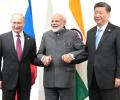
Prime Minister Narendra Modi said he looks forward to useful conversations with his fellow leaders from China, South Africa, Brazil and Russia on addressing pressing international and regional challenges that stand in the way of their goals.
The Prime Minister Manmohan Singh on Tuesday mooted an Asian Economic Community encompassing ASEAN, China, Japan, Korea and itself to integrate Asia and promote regional cooperation.

India is well positioned to lead the global transitions of digital and artificial intelligence, energy, value supply chains, and the country's growth journey will shape the world's future, B20 India chair N Chandrasekaran said on Friday. In his address to the B20 Summit India 2023, Chandrasekaran, who is also the chairman of Tata Sons, asserted that India stands as a beacon of growth and positively stands out in the global economy, which is facing strong headwinds, tightest rate cycle in decades and record levels of public debt. "The world is currently navigating through three important fundamental transitions.
As US President Joe Biden launched a new trade deal with 12 Indo-Pacific nations, including India, to enhance trade, economic and investment opportunities, China, which sees the pact as a threat to its dominance in the region, went on the offensive against it, promising more opening up, while the official media here termed it as "economic Nato".

After visiting two Central Asian countries, Prime Minister Narendra Modi arrived in Ufa on Wednesday on a three-day trip during which he will attend the BRICS and Shanghai Cooperation Organisation summits.
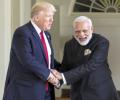
Trump lauds Modi, saying he has been working successfully to bring the vast country and its people together.

Indian CEOs already have most of the skills to take on the world.
The participation of 600 participants from 32 countries is a clear indication of India's growing international profile and the confidence of the global business community in the country.
The prime minister will be assisted by Planning Commission Deputy Chairman Montek Singh Ahluwalia, India's Sherpa to the G20 process.

Opportunity for India to take leadership in economic diplomacy.
Markets regulator Securities and Exchange Board of India (Sebi) is stepping up efforts to ease the onboarding of foreign portfolio investors (FPIs) and has constituted a cell for consultations with offshore investors and custodians, said whole-time member Ananth Narayan. Sebi is also working to make regulations more "light-touch" for FPIs that invest exclusively in government securities or are sovereign funds. The regulator is trying to make the registration process easier for such FPIs, the Sebi official said at the CII Financing 3.0 Summit in Mumbai.

'The 2024 election results will lead to much intense targeting of Modi, more intense debates, many more breakdowns in Parliament and many more movements on the streets.' 'The results have hit Modi's standing, and the politics of the Opposition parties will be sharply focused to ensure that Modi doesn't get back his charisma of being 'invincible' with help of State power.' Sheela Bhatt looks at the political situation through the prism of 2024 Lok Sabha election results.
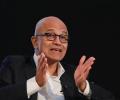
Microsoft chairman and CEO Satya Nadella on Wednesday highlighted the importance of driving inclusivity and empowerment through technology and economic growth and asserted that the company is "very committed to India". He was speaking at Microsoft's Tech for Good and Education showcase, an event that highlighted the impact created by technology in the areas of philanthropic work and education. Nadella did a walk through, interacting with teachers, students and professionals who are making a difference in the society, by leveraging various Microsoft programs, initiatives and tools.

The enduring legacy of trade routes lies in shared stories and religious diversity. Can the India-Middle East-Europe Economic corridor harness this legacy to empower nations, asks Arundhuti Dasgupta.

He said India would continue to actively pursue and promote its geo-political, strategic and economic interests on the seas, in particular the Indian Ocean.

The two sides held discussions on enhancing investment in technology, renewable energy and food security.

Modi said New Delhi has emphasised on dialogue and diplomacy along with restraint to deal with the situation arising out of the Hamas-Israel conflict.
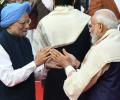
While Narendra Modi spent fewer days abroad than his predecessor -- 275 days versus Dr Singh's 306 - he has travelled more widely than any other Indian PM.

India said a new mechanism will be set up for issues relating to trade and investment.
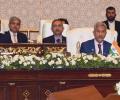
Delivering a thinly veiled message to Pakistan from its soil, External Affairs Minister S Jaishankar on Wednesday said activities across borders characterised by the 'three evils' of terrorism, extremism and separatism are unlikely to encourage trade, energy flows and connectivity.

Modi emphasised that it was necessary to work together for sustained global economic recovery.

India is in a much better position to deal with the challenges related to growth and inflation, said Sanjiv Bajaj, president of industry body CII. According to official figures, India's retail inflation continues to remain above the Reserve Bank's tolerance level of 6 per cent since January, while the economic growth in the first quarter of the fiscal was 13.5 per cent, lower than the central bank's estimate of 16.2 per cent. "I don't want to say we don't have our own challenges with growth, with inflation but we are in a much better position and credit must go to everybody including the central and state governments.

On Day 2 of the summit, Modi and Xi held a fresh round of one-on-one discussion at the Taj Fisherman's Cove Hotel.

Modi attended the 20th ASEAN-India Summit in Jakarta. Secretary-General of ASEAN Dr Kao Kim Hourn also attended the summit.

India, along with Pakistan, is set to be inducted as full members into the bloc, which mainly deals with issues relating to security and defence.

The external affairs minister said the SAARC is in trouble as one of its members has been supporting terrorism.

The members of the grouping made it clear that they were against the use or threat of use of nuclear weapons and sought "peaceful resolution of conflicts."
